Quality of Decision (QoD): The Missing Layer in Agentic AI Systems

How to design AI that knows when it’s right, when it’s wrong, and when it should ask for help

1. The Hidden Weakness in Today’s Agentic AI

Agentic AI is advancing quickly. We’re seeing systems that can plan tasks, call tools, analyze data, trigger workflows, and even collaborate with other agents. The idea of “autonomous workflows” is no longer a futuristic dream – it’s rapidly becoming a reality. But there’s a critical blind spot in much of this exciting technology: a fundamental lack of judgment.

And yet, most of these systems still fail in the same predictable way. This failure isn't usually due to a weak LLM, a poorly designed architecture, or missing tools. Instead, they fail because the system simply cannot judge its own decisions. It doesn’t know when the input data is incomplete, when the reasoning is shaky, or when an action is too risky. And, in most cases, it never asks for help. This is exactly the gap that Quality of Decision (QoD) fills.

If LLMs give us intelligence, then QoD gives us judgment—and judgment is what makes autonomy safe and scalable.

2. What QoD Really Means?

QoD may sound abstract, but at its core, it answers a very practical question: “Is this decision good enough to trust?” A high-quality decision is clear, well-reasoned, data-driven, and safe to execute. A low-quality decision is uncertain, incomplete, or simply wrong – but wrapped in confident language.

Think of it like this: A system might confidently recommend a product based on limited information, while QoD would recognize the potential for a mistake and trigger a check for more data.

Confidence is about how the model feels. QoD is about how strong the decision actually is. QoD gives the system a sense of self-awareness. It helps an agent recognize when it should move forward, when it should step back, when it should double-check with another agent, or when it should ask a human. In other words, QoD gives autonomy the ability to behave responsibly.

3. Where QoD Fits in the Agentic Architecture

Most diagrams of agentic systems look like this:
_- visual selection (7)
Conceptually simple, but incomplete.
Real systems need an additional checkpoint between “Plan” and “Execution”—a moment where the agent stops and asks: “Is this a good idea?”
The more accurate architecture looks like this:
_- visual selection (5)
This small change drastically improves reliability. Without this checkpoint, the agent moves blindly through the workflow. With it, the agent becomes capable of:
  • Recognizing poor reasoning 
  • Identifying missing context 
  • Detecting contradictions 
  • Avoiding risky actions 
  • Requesting help before making mistakes
_- visual selection (4)
QoD isn’t decoration. It is the gatekeeper that gives an agent discipline.

4. Why QoD Matters in Real Systems: Avoiding Costly Mistakes

If you’ve worked with LLM-based agents, you’ve probably seen the same issues repeat again and again. Sometimes the agent produces an answer that sounds brilliant but is completely wrong. Sometimes it continues a workflow even though a key piece of information is missing. Sometimes two agents disagree, and the system has no idea what to do. Sometimes a minor mistake becomes a major issue because nothing intervenes.
None of this is surprising. Without QoD, agents cannot assess the strength of their own decisions. They simply assume their reasoning is valid because the language is coherent.
QoD acts like a safety net. It stops the system before the problem grows. It catches the weak decisions early, while there’s still time to correct them. This is the difference between a demo agent and a production-ready autonomous system.

5. Telecom and AI-Native Networks: A Lesson in Judgment

If you come from the world of autonomous 5G/6G networks, this story feels very familiar. Telecom systems have been “multi-agent” long before the term became popular. Mobility optimization, resource scheduling, anomaly detection, predictive analytics – they all rely on distributed intelligence.
And the telecom world learned something important: autonomy without judgment is dangerous. This is why networks use confidence estimation, fallback logic, independent cross-checking, strict safety boundaries, and “autonomy levels” instead of unlimited freedom.
These same principles apply directly to agentic AI. Agents shouldn’t either.

6. How QoD Works Behind the Scenes: A Simple, Effective Approach

QoD doesn’t require a complicated formula or advanced theory. It simply evaluates the ingredients behind the decision: Is the information complete? Does the reasoning follow a clear structure? Did the model express uncertainty? Does the plan contradict earlier steps? Did another agent disagree? Does this action carry risk?
From signals like these, the agent forms a “decision strength.” If the strength is high, it proceeds. If it’s moderate, it revises the plan. If it’s low, it escalates or stops. This turns the workflow from a linear chain into a guided loop – much closer to how humans operate when uncertainty is high.
Good agents don’t push forward blindly. They adjust.

7. Patterns That Work in Practice: Building Reliable Systems
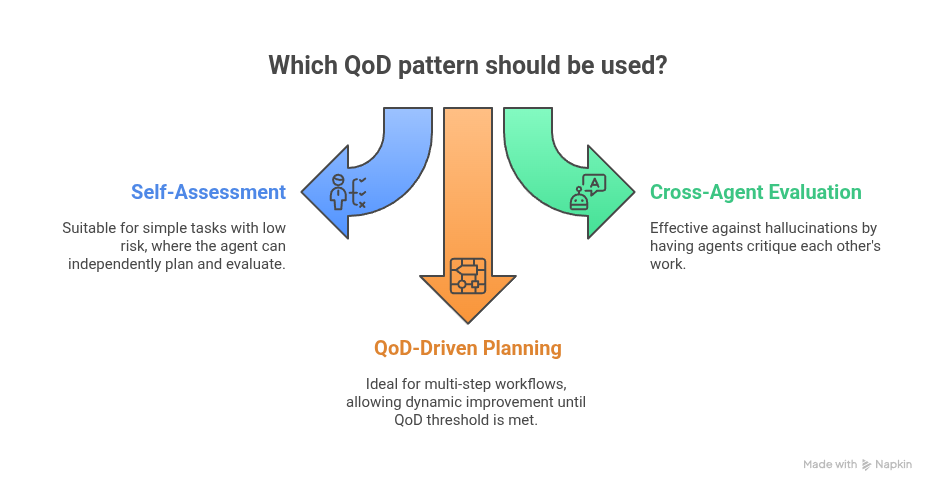
As teams start implementing QoD, three practical patterns show up consistently.
Pattern 1: Self-Assessment: The agent generates a plan and also evaluates it. Useful for simple tasks where the risk is low.
Pattern 2: Cross-Agent Evaluation: Two (or more) agents independently produce an answer and critique each other. Surprisingly effective against hallucinations.
Pattern 3: QoD-Driven Planning: The plan evolves dynamically. The agent improves the steps until the QoD score reaches an acceptable threshold. Ideal for multi-step workflows.
_- visual selection (6)


These patterns grow more powerful when combined, especially in systems that require long sequences of reasoning.

8. From a Leadership Perspective Approach

From a leadership and organizational perspective, QoD isn’t a technical feature – it’s a trust layer. Companies want AI systems that behave predictably, especially when decisions affect customers, revenue, or operations. They want agents that know when they’re uncertain and can communicate that uncertainty clearly.
QoD is the mechanism that gives stakeholders confidence that autonomy is controlled, explainable, and safe. It answers critical questions like: When does the AI escalate? How does it evaluate risk? How do we prevent silent failures? Without QoD, these questions have no clear answer. With QoD, they become part of the system’s design.

9. Bottom Line: QoD is the Bedrock of Real Autonomy

Agentic AI is evolving quickly, but intelligence alone isn't enough. To build systems that are truly autonomous—systems that can adapt, revise, correct themselves, and avoid harmful actions—we need to give them judgment. QoD is the layer that makes autonomy responsible. It helps an agent know when it’s confident, when it’s uncertain, when it needs help, and when it should pause. It turns blind execution into thoughtful action. And as the field moves from prototypes to production systems, QoD will become the standard way we design reliable AI. It’s not a nice-to-have. It’s the foundation of real autonomy.

If you’re building agentic systems and want to talk about QoD frameworks, feel free to connect on LinkedIn or send an email.